
The Glass House
A Discarded Chapter

I am probably permanently blocked in writing my novel “Sleeping Dog”. I have been going through all the discarded chapters, looking for meat for the novel. This fragment was written around the turn of the century. I have rewritten it three times, and a version of it lives on (without the bullets) in the current novel. Somewhere is a novella that uses this as a starting chapter, but it was terrible, and I never tried to sell it.
I am including it here because I will do anything to avoid actually working on my novel.
This image is a painting by Tony Zeigler, my cousin. He passed away a few months ago and at his memorial service everyone was encouraged to take a painting. I want to use this as a book cover, but first I have to write the book.
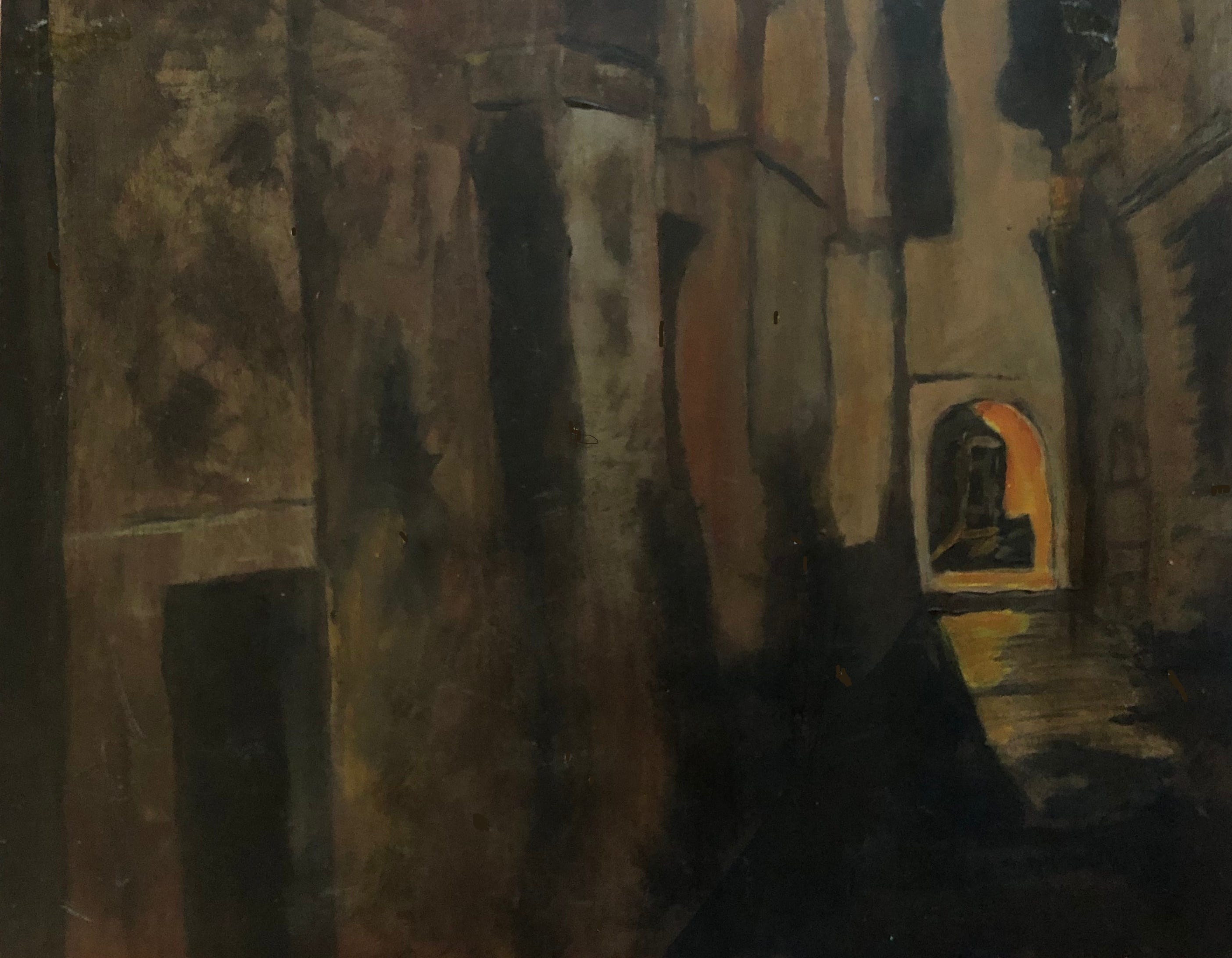
The Glass House
The glass house held the corporate servers, mainframes, and neural networks of SDI Corporation. It got its name from the wall of glass that separated the computer room from the rest of the world. It was located in the second sub-basement, far from the dangers of the surface world.
At two o’clock in the morning, the persistent sound of the glass house was an annoying hiss of fan noise. Mark Suarez saw the flash of the gunfire, but he didn’t hear it. He was talking on the phone at the communications help desk.
A firecracker had ruined Mark’s hearing in his left ear twenty years before, and the white hiss of background noise echoed loudly through his head, making it hard to hear normal conversation. He had to hold the phone tight to his right ear with his hand over his left ear in order to work. The harsh tile floors and painted concrete block walls did nothing to muffle the sounds of hundreds of muffin fans blowing air over hot integrated circuits. The HVAC units, rumbling in the background, carried away the hot air and kept the room at a constant65 degrees.
Mark saw the flash reflected off the glass. He saw the thick glass quivering. He turned his attention from the conversation in time to see Stephanie Black, the forms-control person, thrown against a wall on the other side of the glass. Her body shuddered as it was ripped to pieces by bullets from an assault rifle. She slid down behind the low wall at the base of the glass.
“I have to hang up,” Mark said into the phone.
A hooded figure in green and brown camouflage overalls stepped into Mark’s field of vision. It leaned over Stephanie’s body and fired one shot straight down. Mark was glad he couldn’t see her anymore.
Mark stepped back behind a bank of network routers and watched through the small gaps between the racks. He felt invisible behind the rows of red blinking lights. Three more figures dressed as camouflaged commandos moved in behind the glass wall. They stopped at the security door. It required that the person enter a code number in the keypad and then place the palm of their hand on a scanner platen. If the palm print matched the number, the door would open.
There was much discussion and an aborted attempt to lift Stephanie’s body up far enough to use her hand when Paul Stamford, a night operator, jumped up from a hiding place behind a disk array and dashed for the fire exit at the opposite end of the glass house. The operator was making a good show of it when one of the invaders noticed him and cut him in half with a prolonged burst from his rifle. This also solved the entry problem when the glass wall came down in a million pieces.
The four commandos jumped over the remaining shards of glass and ran into the room. One of the operators and a data librarian made a frantic dash for the exit, and neither survived. It was time, thought Mark, to disappear. He dropped behind his desk and tugged on a floor tile. There was a tile puller with a suction device on it somewhere, but there was no time to find it. He scraped at the tile with his nails and managed to pull it up. He crawled in, replacing the tile over him. Older computer rooms have raised floors used for cables and airflow. There were about 30 inches of room. Mark could see a little in the dim light. The holes cut in the floor for fiber optic cables and coax runs let some light in. The metal lattice that held the tiles was not all even and provided additional light.
There was a burst of gunfire as another of Mark’s coworkers died. The commandos were securing the glass house. Mark slowly crawled under the floor towards the fire entrance. He could come up anywhere that he wanted to. The tiles could be pushed up easily from underneath but were hard to get up without a tile puller. He squirmed his way around large, snaking cables. The floor underneath him suddenly became wet and sticky. He nearly retched when he realized that he was crawling through someone’s blood that was dripping down from above.
Mark couldn’t hear any more activity above him. He wondered if the people with guns were purposely being quiet, listening for something. He stopped crawling. Mark didn’t want to make any noise that might draw their attention.
“Where is it?” he heard a man’s voice say. They were looking for something. This was a large corporate data center. There was valuable information stored in the databases here, but Mark could not imagine what would be worth killing someone over.
“Look for a large red ‘G’.” another answered.
Mark almost gasped. They were looking for Golem! Mark had heard a little about the Golem project by listening to water cooler gossip. It was an extremely expensive government contract.
Golem was not yet in production. As far as Mark knew, the device had value only as a proof of concept. The neural network was being trained on corporate models. The models were large parallel equations of thousands of variables and thousands of unknowns. AIs such as Golem make heuristic conclusions based on the partial results of solutions to these equations. Whether to buy timber in September, sell CPUs in May, or borrow money in December. These were the kinds of questions that the AI could answer. Golem could do it better than any AI to date, although it was still an infant and wouldn’t be able to produce results for months yet, if ever. If it ever worked, it would be worth billions.
Mark realized that he was directly underneath Golem. The cables snaking about him went to the large arrays of crystal memory and quantum storage that fed the nets. There was also the large insulated tubing that carried the liquid nitrogen from the compressors located a few feet away. They were not going to steal Golem; the nets would degrade in a few seconds if removed from their constant supply of liquid nitrogen. If anyone turned off Golem, the AI would crash, and it would take days to get it restored from the backups.
It was the data module! Mark realized they were going for a backup data module. Golem was made from off-the-shelf components, arranged in unremarkable ways. The AI was unique because of its programming. There were five recent backups of Golem’s programming. One was in the secure Iron Mountain facilities. Three were in the data vault that was on a time lock and would not open until the next day at 4 PM, and one was sitting in the data drive mounted on Golem’s rack, directly above Mark. The expert system front-end system ran a daemon program that recorded progressive changes in the AI’s programming every few seconds. This data module was a snapshot of Golem’s neural net and was the only way to reload it in case of system failure.
Mark did a stupid thing. He pushed up a tile about eight inches, reached up, and pulled out the module. It was a warm lump of black plastic, the size and shape of a lightly rounded construction brick. Recessed along one end was a row of golden contacts that were used to access the terabytes of data that the module held. He dropped the tile as quietly as he could and listened. There was no sound. Mark started to crawl towards the fire escape. No one had seen him. Golem began to beep as an alarm reported the empty data drive. The beeps must have attracted the attention of one of the commandos, because Mark could hear the crunch of combat boots above him. They walked directly over him and towards Golem.
“Here it is,” the voice called. More boot sounds as the commandos gathered from other parts of the glass house.
“Where’s the data module?” one asked, and Mark almost laughed in triumph. He had foiled them! “There’s supposed to be a data brick in the drive.”
“It just started beeping, and I came and looked, and there was no module.” The commando answered.
“Wait,” said a strangely familiar female voice, “you say it just started beeping?”
There was a moment of silence, then the female voice said quietly, “There’s somebody here.”
Mark could feel them looking at the floor and knew that it was only a matter of time before they found him, and it would be his blood pooling underneath the tiles of the raised floor.
“Spread out. Look behind and under everything!” The woman’s voice said. There was a pause as feet crunched in all directions. Mark squirmed as quickly as he could towards the fire exit without making any noise. Thirty inches isn’t much room. Mark suffered, as many techies did, from eating too much delivery pizza. He found his backside was always bumping into the tile supports above him as he tried to crawl. The floor joists and supports made obstacles that he had to crawl under with his back to the floor. He could hear the boots above him moving about, looking behind every disk array and CPU rack.
A pair of running feet passed directly over him. Mark froze in fear. After they passed, he increased his efforts. He bumped the tiles hard as he crawled. It was at a moment that no one was moving or talking on the floor up above him. Mark stopped moving again and listened to see if they had heard him.
“Someone help me get these tiles up. He’s got to be under the floor,” the woman’s voice called out.
Mark had trouble controlling his bladder. He felt horribly sick to his stomach, and he was breaking out in a cold sweat. He had done a stupid thing, and it was going to get him killed. Mark crawled quickly to one of the large concrete support pillars that ran up through the floor to the ceiling. He could hide himself behind this if anyone pulled a tile and started looking for him.
One of the intruders found the tile puller and pulled up the tiles where Mark had entered the raised floor. Another tile started to go up near the Golem computer. They pried it up with a large knife. Mark squirmed one way and then another, trying to avoid detection. He got as much behind the pillar as possible and tried to flatten himself on the floor. He saw a head with its back to him come down a hole. Mark put his head down so the reflection from his glasses would not betray him. He was wearing a dark knit shirt and jeans, but Mark’s skin was a pale brown and was rarely exposed to the sun. He tried to cover as much of it as possible with his arms. Mark hoped that the piles of cables along the floor would help to hide him. He tried to think like just another pile of junk. He was holding his breath and suddenly felt that he had to breathe and that his gasp for air would be heard. Another head came down from the tile nearer his hiding place. He could not hide from both.
The glaring fluorescent lighting poured into the two holes, illuminating the floor with a revealing light. The area under the floor must have appeared impossibly dark compared to the daylight-bright glare of the glass house. Mark hoped that he would be just a dim lump in the gloom. He held his hand over his mouth and let out his breath slowly. He breathed in again, just as slowly. His pulse felt like it was going at nearly 200 beats per minute. He would faint if he kept this up for much longer.
“Do you see him?” a voice asked. Please, thought Mark, let the answer be NO.
“Not yet.” The woman’s voice answered. Mark was sure that he knew who it was, but he couldn’t put a face or a name with the voice. “He’s got to be under here. I know I heard him.”
“We don’t have time for this.” The other person said. “We’ve got a schedule to keep. I’m not getting killed. We’ve got to get the hell out of here, now.”
“Someone’s got the damn backup!” The woman yelled.
The fire alarm started to sound. There was a scurry of feet above Mark and the words “Go! Go! Go!” as the intruders fled. There was no more discussion, and soon there were no sounds except the constant fan noises. Mark’s damaged ears struggled to penetrate the constant white noise of the fans. With a shock, the distant rat-a-tat of gunfire echoed through the halls and passageways.
Then Mark heard something else. Mark thought that he heard a hissing sound that was different from the fan noise. He sniffed the air and smelled the stale smell of the FIC flame suppression system. The fluorocarbon molecules replaced oxygen in the air and starved fires. Although they were essentially non-toxic, they had the unfortunate side effect of suffocating humans.
Mark remembered thinking that it might, at last, kill all the cockroaches in the coffee room. His arms felt too weak to hold him up. His head fell forward as the muscles on his neck relaxed. Mark never lost consciousness but stayed on the edge of sleep while dark shapes rose and streamed through his field of vision like smoke.
The blowers came on with a screech of drive belts and the deep bass of moving air. Mark’s head hurt. He had been in a dream where he was trying to run. His arms and his legs would not work in the dream, and when he screamed, no sound would come from his mouth.
There were feet pounding on the floor over Mark’s head. He rubbed his eyes hard and shook his head to clear it. It felt like his brain was bouncing around inside his skull. Mark suppressed a moan and slowly crawled under the floor until he hit a wall. He pushed up a floor panel and came up in a small office. He replaced the floor panel carefully.
Mark couldn’t stay standing and sat against the wall with his head between his knees.
The FIC flame suppressant was not supposed to be poisonous, but Mark had nearly suffocated, and his head ached like the worst hangover that he’s ever had. The operations manager’s name was Molly. She kept a small cube refrigerator in her office. Mark opened it, found a soft drink, and opened it. He would repay Molly later, if she was still alive.
The caffeine in the drink began to straighten out Mark’s complaining nerve cells. He stood up and looked out the door’s glass window. Men in uniforms, large guns, and gas masks were moving about. One of them saw him. Mark opened the door and walked out into the glass house.
“Who are you?” the cop asked.
“My name is Mark Suarez.” Mark’s throat was still dry, despite the soft drink. “I work as a data analyst. I got gassed.”
“Did you see what happened here?” the man’s voice was muffled by his gas mask.
“I saw a little. I hid when they started shooting.”
The cop reached out and took hold of Mark’s arm. He called to another uniformed man. “Hey, Tony! We got another witness.” The other man walked up. “Take him upstairs and let Mason talk to him.” Possession of Mark’s arm passed to the second cop, who started to walk towards the shattered glass entrance.
A cop on his knees near the operations console desk called out. “We got a live one. Get the medics down here fast.”
The man holding on to Mark’s arm said, “Don’t go nowhere.” and ran to help with the injured person. All Mark could see was a long pair of legs sticking out from under a chair. The designer jeans were dark with blood. It was Molly, the operations manager. Mark might not be able to reimburse her for the drink.
Mark wandered towards the glass house’s entrance, stepping carefully over the shattered glass and trying not to look at the bullet-riddled bodies of his coworkers. One of the cops found him and guided him. They made it to the elevator and went up to the third floor. They didn’t stop at the lobby. He guessed rightly that the emergency services crews were organizing there.